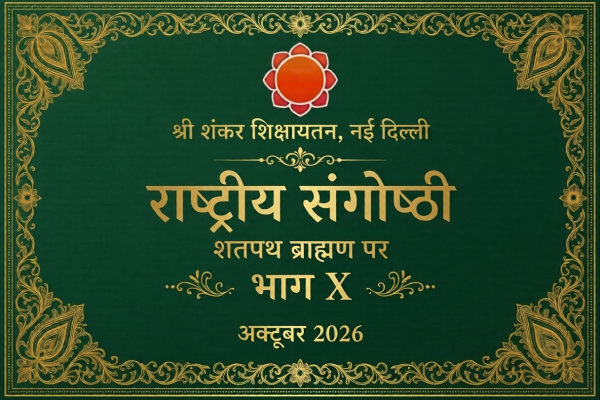
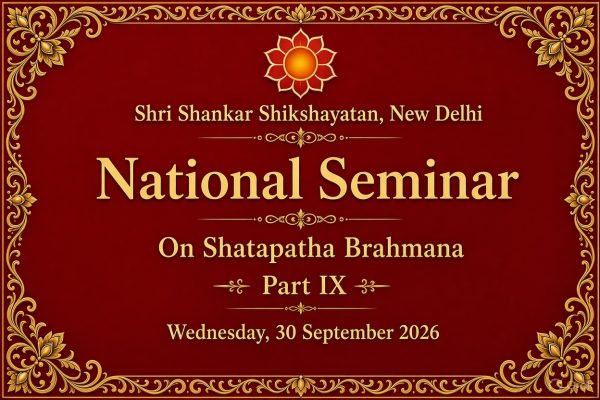
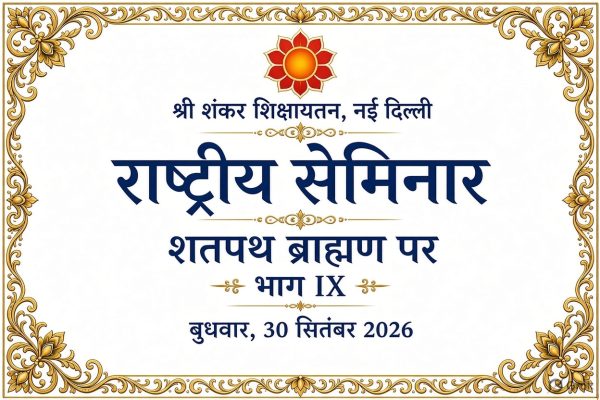
राष्ट्रीय संगोष्ठी -शतपथ ब्राह्मण भाग X

अक्टूबर 2026 श्री शंकर शिक्षायतन आपको अक्टूबर 2026 में शतपथ ब्राह्मण पर हमारी दसवीं चर्चा में आमंत्रित करने में प्रसन्न है। यह पंडित मोतीलाल शास्त्री के शतपथ ब्राह्मण विज्ञान भाष्य पर हमारी वार्षिक संगोष्ठी श्रृंखला का हिस्सा है।

Read More

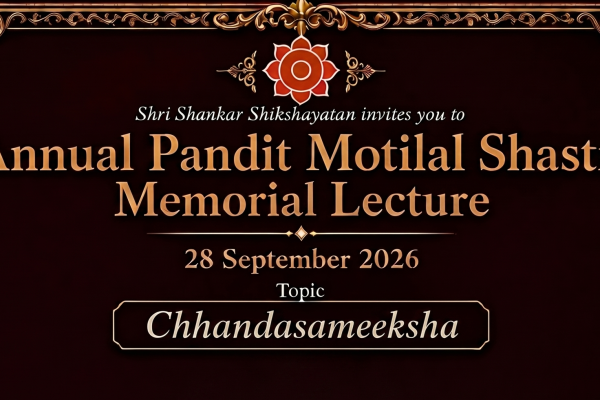
पण्डित मोतीलाल शास्त्री स्मृति व्याख्यान 2026

श्री शङ्कर शिक्षायातन २८ सितम्बर २०२६ को वार्षिक पण्डित मोतीलाल शास्त्री स्मृति व्याख्यान २०२६ प्रस्तुत करते हुए प्रसन्नता का अनुभव करता है। इस व्याख्यान का विषय है — छन्दसमीक्षा। छन्दःशास्त्र के विश्लेषण हेतु पंडित मधुसूदन ओझा जी ने इस ग्रन्थ की रचना की है । इस ग्रन्थ में छन्दस्तत्त्व की समीक्षा की गयी है जिसमें पद्यच्छन्दोवेदगत शिक्षा, गणित, निरुक्ति, व्याकरण व कल्पभेद से पाँच अङ्ग प्रतिपादित हैं । अर्थात् इस पद्यच्छन्दोवेद में छन्दःशिक्षा, छन्दोगणित, छन्दोनिरुक्ति, छन्दोव्याकरण एवं छन्दोकल्प इन पाँच अङ्गों का निरूपण किया गया है ।

Read More

Annual Pandit Motilal Shastri Memorial Lecture 2026

September 28,2026 Shri Shankar Shikshayatan is happy to present the Annual Pandit Motilal Shastri Memorial Lecture 2026 on September 28, 2026. The topic of the lecture is Chhandasameeksha. Pandit Madhusudan Ojha composed Chhandasameeksha as a systematic analysis of Chhandashastra, presenting chhandas not merely as the study of poetic metre but as a comprehensive discipline with its own principles, terminology, mathematics, grammar, and applications. The work examines the fundamental nature and structure of Chhandastattva and identifies five principal branches of the Padyachhandoveda: Chhandashiksha (the science of metre), Chhandoganita (the mathematics of metre), Chhandonirukti (etymological analysis), Chhandovyakarana (grammar of metre), and Chhandokalpa (the systematic application and ritual framework of metre). Through these five limbs, Ojhaji presents chhandas as an integrated system in which linguistic structure, mathematical order, and the principles governing poetic form are closely interconnected. Hindi translation: पण्डित मोतीलाल शास्त्री स्मृति व्याख्यान 2026 श्री शङ्कर शिक्षायातन २८ सितम्बर २०२६ को वार्षिक पण्डित मोतीलाल शास्त्री स्मृति व्याख्यान २०२६ प्रस्तुत करते हुए प्रसन्नता का अनुभव करता है। इस व्याख्यान का विषय है — छन्दसमीक्षा। छन्दःशास्त्र के विश्लेषण हेतु पंडित मधुसूदन ओझा जी ने इस ग्रन्थ की रचना की है । इस ग्रन्थ में छन्दस्तत्त्व की समीक्षा की गयी है जिसमें पद्यच्छन्दोवेदगत शिक्षा, गणित, निरुक्ति, व्याकरण व कल्पभेद से पाँच अङ्ग प्रतिपादित हैं । अर्थात् इस पद्यच्छन्दोवेद में छन्दःशिक्षा, छन्दोगणित, छन्दोनिरुक्ति, छन्दोव्याकरण एवं छन्दोकल्प इन पाँच अङ्गों का निरूपण किया गया है ।

Read More

National Seminar on Shatapatha Brahmana: Purodasha-Sampadana- Series 7

Report Shri Shankar Shikshayatan Institute of Vedic Research organised a national online seminar on Friday, 31 July 2026. The seminar examined the chapter entitled “Purodasha-Sampadana Karma” from Shatapatha Brahmana Vijnana Bhashya, the celebrated commentary authored by Pandit Motilal Shastri. The seminar formed part of a continuing series devoted to the scientific and philosophical themes discussed in the Shatapatha Brahmana. Prof. Sundar Narayan Jha, Professor, Department of Veda, Shri Lal Bahadur Shastri National Sanskrit University, New Delhi, explained that Svayambhu, Parameshthi, the Sun, the Moon, and the Earth constitute the five fundamental principles responsible for the differentiation of creation. Among these, Svayambhu and Parameshthi possess an immortal (amrita) nature. The Sun embodies both immortal and mortal aspects, whereas the Moon and the Earth are characterized by the mortal aspect. r\Referring to the statement from the Shatapatha Brahmana: तस्मात् यत् किञ्च अर्वाचीनम् आदित्यात् सर्वं तन्मृत्युना अप्तम् ।Tasmad yat kincha arvacinam adityat sarvam tan mrityuna aptam(“Therefore, whatever is posterior to the Sun is attained through mortality.”), He explained that the nature of the Earth and the Moon is determined on this basis, since both are later than the Sun. He further interpreted the mantra ‘निवेशयन् अमृतं न मर्त्यं च’-“Niveshayan amritam na martyam cha” to explain the dual nature of the Sun. (Shatapatha Brahmana, p. 540) Dr. Durga Sharan Rath, Assistant Professor, Department of Veda, Central Sanskrit University, Shri Raghunath Kirti Campus, observed that the commentary encompasses numerous philosophical themes. The present chapter particularly expounds the doctrine of Triadicism (Tritvavada). According to the principle: Trih satya va devatah (“The deities are threefold in truth.”), the doctrine of triadicity is established. The Rigveda, Samaveda, and Yajurveda constitute a triad. Likewise, the deities are arranged in triads, and even in traditional practice Vedic benedictions are recited three times. The Shatapatha Brahmana Vijnana Bhashya presents numerous illustrations of this principle, including: In all, the commentary discusses eight such examples in detail. (Shatapatha Brahmana, p. 511) Dr. Sudhakar Kumar Pandey, Assistant Professor, Department of Veda, Central Sanskrit University, Jaipur Campus, stated that the present chapter gives a significant exposition of Prajapati. Two forms of Prajapati are described in the context of the Black Antelope (Krishna Mriga): Satya Prajapati and Yajna Prajapati. Satya Prajapati represents the original or essential principle, while Yajna Prajapati represents the functional or derived principle. Satya Prajapati is the very foundation upon which the sacrifice (yajna) is established. (Shatapatha Brahmana, p. 467) Dr. Nishant Mishra, Assistant Professor, Department of Veda, Central Sanskrit University, Ekalavya Campus, explained that the entire universe is divided into five principal realms: Svayambhu as the first, Parameshthi as the second, the Sun as the third, the Moon as the fourth, and the Earth as the fifth. Owing to this fivefold division, the concept of Pancha-Pundira Prajapatya Balsha is described, one of whose branches begins with Svayambhu. Svayambhu and Parameshthi together constitute the Supreme Realm (Parama Dhama); the Sun is designated as the Middle Realm (Madhyama Dhama); while the Moon and the Earth together form the Lower Realm (Avara Dhama). (Shatapatha Brahmana, p. 572) The seminar commenced with the recitation of Vedic invocatory hymns by Dr. Amand Mishra, Assistant Professor, Department of Veda, Central Sanskrit University, Shri Raghunath Kirti Campus. The proceedings were conducted by Dr. Lakshmi Kant Vimal, Research Officer, Shri Shankar Shikshayatan Institute of Vedic Research. Faculty members, research scholars, and Sanskrit enthusiasts from universities and colleges across several states participated enthusiastically, contributing to the successful conduct of the seminar.

Read More

राष्ट्रीय संगोष्ठी शतपथब्राह्मणविज्ञानभाष्य : पुरोडाशसम्पादन विमर्श -शृंखला-७

प्रतिवेदन श्रीशंकर शिक्षायतन वैदिक शोध संस्थान द्वारा दिनांक ३१ जुलाई २०२६, शुक्रवार को सायंकाल ५-७बजे तक अन्तर्जालीय माध्यम से राष्ट्रीय संगोष्ठी का समायोजन किया गया। पण्डित मोतीलाल शास्त्री प्रणीतशतपथब्राह्मणविज्ञानभाष्य नामक ग्रन्थ के ‘पुरोडाशसम्पादन कर्म’ नामक प्रकरण पर विचार किया गया। इसब्राह्मणग्रन्थ के विविध विषयों को आधार बना कर यह राष्ट्रीय संगोष्ठी समायोजित की गई थी। प्रो. सुन्दर नारायण झा, आचार्य, वेद विभाग, श्री लाल बहादुर शास्त्री राष्ट्रीय संस्कृत विश्वविद्यालय,नई दिल्ली ने कहा कि स्वयम्भू परमेष्ठी सूर्य चन्द्रमा और पृथ्वी ये पाँच सृष्टि के विभाग करने वाले तत्त्व हैं।उनमें स्वयम्भू और् परमेष्ठी इन दोनों का अमृत स्वरूप है, सूर्य का अमृत और मर्त्य स्वरूप है तथा चन्द्रमा औरपृथ्वी इन दोनों का मर्त्य स्वरूप है। तस्मात् यत् किञ्च अर्वाचीनम् आदित्यात् सर्वं तन्मृत्युना अप्तम् । (इस प्रकारजो कुछ आदित्य से नवीन है, वह सब मृत्यु के द्वारा प्राप्त होता है), इस शतपथब्राह्मण के वचनों के आधार पर,पृथ्वी एवं चन्द्रमा का स्वरूप निर्धारित किया गया है। क्योंकि आदित्य से नवी ये दोनों तत्त्व हैं। ‘निवेशयन्अमृतं न मर्त्यं च’ इस मन्त्र के आधार पर सूर्य की व्याख्या की गयी है। (शतपथब्राह्मण पृ. ५४०) डॉ. दुर्गा शरण रथ, सहायक आचार्य, वेद विभाग, केन्द्रीय संस्कृत विश्वविद्यालय, श्रीरघुनाथकीर्तिपरिसर ने कहा कि इस भाष्य में विविध विषय हैं। प्रस्तुत प्रकरण में त्रित्ववाद की व्याख्या की गयी है। ‘त्रिःसत्या वा देवता’ इस सिद्धान्त के अनुसार त्रित्ववाद की सिद्धि होती है। ऋग्वेद, सामवेद और यजुर्वेद ये तीनवेद त्रित्ववाद में आते हैं। देवता भी त्रित्ववाद में समाहित हैं, लौकिकव्यवहार में भी वैदिकमङ्ल का पाठ तीनबार किया जाता है। त्रित्ववाद के अनेक उदाहरण शातपथब्राह्मण हिन्दीविज्ञान भाष्य में देखने को मिलता है।जैसे- पृथ्वी, अन्तरिक्ष और द्युलोक- ये तीन त्रैलोक्य हैंअग्नि, वायु आदित्य- ये तीन देवता हैं।वसु रुद्र आदित्य- ये तीन अधिदेवता हैं। इस प्रकार से आठ उदाहरणों का विस्तार से वर्णन प्राप्त होता है। (शतपथब्राह्मण पृ. ५११) डॉ. सुधाकर कुमार पाण्डेय, सहायक आचार्य, वेद विभाग, केन्द्रीय संस्कृत विश्वविद्यालय, जयपुर परिसर नेकहा कि प्रस्तुत प्रकरण में प्रजापति का महत्त्वपूर्ण वर्णन किया गया है । इस प्रजापति के सत्यप्रजापति और यज्ञप्रजापतिये दो रूप हैं कृष्णमृग के प्रकरण में इसका वर्णन आता है। सत्यप्रजापति मैलिक तत्त्व है। यज्ञप्रजापति यौगिक तत्त्व है।सत्यप्रजापति ही यज्ञ की प्रतिष्ठा है। (शतपथब्राह्मण पृ. ४६७) डॉ. निशान्त मिश्र, सहायक आचार्य, वेद विभाग, केन्द्रीय संस्कृत विश्वविद्यालय, एकलव्य परिसर नेअपने व्याख्यान के क्रम में कहा कि यह संपूर्ण सृष्टि पाँच भागों में विभक्त है। उनमें स्वयम्भू पहला है, परमेष्ठीदूसरा है, सूर्य तीसरा है, चन्द्रमा चौथा है और पृथ्वी पाँचवीं है। इस विभाग के कारण ही पञ्चपुण्डीरा प्राजापत्यबल्शा कहा जाता है। जिसकी एका शाखा स्वयम्भू आदि हैं। स्वयम्भू और परमेष्ठी ये दोनों मिलकर परमधामकहलाते हैं, सूर्य को मध्यमधाम कहा जाता है, चन्द्रमा और पृथ्वी ये दोनों मिलकर ही अवरधाम कहलाते हैं।(शतपथब्राह्मण पृ. ५७२) केन्द्रीय संस्कृत विश्वविद्यालय, श्रीरघुनाथकीर्ति परिसर के वेदविभाग के सहायक आचार्य डॉ. अमन्दमिश्र ने सस्वर वैदिक मङ्गलाचरण का पाठ किया। कार्यक्रम का सञ्चालन श्रीशंकर शिक्षायतन वैदिकशोधसंस्थान के शोधाधिकारी डॉ. लक्ष्मी कान्त विमल ने किया। इस कार्यक्रम में अनेक प्रान्तों के विश्वविद्यालऔर महाविद्याल के आचार्य, शोधछात्र, संस्कृत विद्या मे रुचि रखने वाले विद्वानों ने उत्साह पूर्वक भाग ग्रहणकर गोष्ठी को सफल बनाया।

Read More

National Seminar on Shatapatha Brahmana–Part VI

Report Shri Shankar Shikshayatan Vedic Research Institute organizsd a National Online Seminar on Monday, 29 June 2026, from 5:00 p.m. to 7:00 p.m. The seminar focused on the chapter titled “Prokshana Karma” (The Rite of Ritual Sprinkling) from Pandit Motilal Shastri’s Shatapatha Brahmana Vijnana Bhashya. The seminar examined various philosophical and ritual aspects presented in this commentary on the Shatapatha Brahmana. Presentations Dr. Praveen Kumar Dwivedi, Assistant Professor, Department of Sanskrit, Prof. Rajendra Singh (Rajju Bhaiya) University, Prayagraj, explained that a narrow or limited outlook signifies constriction and is therefore regarded as the cause of suffering. Such a disposition is considered contrary to the spirit of the Yajna. To overcome this limitation, the sacrificer (Yajamana), while reciting the mantra “Devirapo…”, holds the ritual vessel in the left hand and performs the rite of ritual sprinkling (Prokshana) by raising it upward from the southern direction. He further explained that the water found on the earth is comparatively impure, whereas the water existing in the intermediate region (Antariksha), associated with Indra and infused with the solar life-force (Saura Prana), becomes purified through its association with Vayu (air). This interpretation does not imply that terrestrial water is entirely impure; rather, it emphasizes the superior purity of the celestial waters in relation to earthly water. During the sacrifice, water is lifted from the Prokshani vessel and used in the rite of ritual sprinkling. (Shatapatha Brahmana Vijnana Bhashya, p. 448.) Dr. Rajkishore Arya, Assistant Professor, Department of Samhita and Sanskrit, Faculty of Ayurveda, Banaras Hindu University, Varanasi, stated that the Avyaya Tattva (Immutable Principle) possesses five kalas (manifestations): Ananda (Bliss), Vijnana (Knowledge), Manas (Mind), Prana (Life-force), and Vak (Speech). Among these, Ananda and Vijnana unite with the mind to form Vidya (Knowledge), which is identified with Brahman. Conversely, Avidya (Ignorance) is identified with Karma (Action). The Avyaya Purusha is presented as the fundamental basis of creation. (Ibid., p. 407.) Dr. Neeraja Kumari, Assistant Professor, Department of Sanskrit, Mahant Darshan Das Mahila College, Muzaffarpur, Bihar, explained that the Shatapatha Brahmana Hindi Vijnana Bhashya interprets the five vital airs—Prana, Apana, Vyana, Samana, and Udana—from the perspective of Vedic ritual. Among these, Vyana, situated between Prana and Apana, is symbolically designated as Upanshu-Savana. Apana is identified with Antaryama, while Prana is called Upanshu. Upanshu-Savana is represented by a fixed stone. Prana and Apana are symbolically compared to two stones, and through their interaction, friction is produced upon the Vyana stone. Prana approaches from one side and Apana from the other, while the process of friction takes place at the centre upon Vyana. (Ibid., p. 431.) Dr. Prakash Ranjan Mishra, Assistant Professor, Department of Vedic Rituals and Purohitya, Shri Ramsundar Sanskrit Vidya Pratishthan Adarsh Sanskrit College, Darbhanga, explained that the rite of purification (Pavitrikarana) is performed to remove the demonic or impure tendencies (Asura-bhava) believed to have entered the sacrificial materials. A blade of Kusha grass is split into two parts by making a slit in its middle. The lower portion is called the root, while the upper portion forms the tip. Both portions are placed in the water contained in the Prokshani vessel, and this Kusha grass is used periodically for the rite of ritual sprinkling throughout the sacrifice. (Ibid., p. 428.) The seminar was chaired by Prof. Santosh Kumar Shukla, Professor, Institute of Sanskrit and Indic Studies, Jawaharlal Nehru University, New Delhi. In his presidential address, he explained that Yajnas are broadly classified into two principal categories: Vitana Yajna and Paka Yajna. The former is associated with the Shrauta sacrificial tradition, while the latter belongs to the Smarta tradition. The Grihya Sutras provide a detailed exposition of the Paka Yajnas. He further observed that the entire universe itself may be understood as a continuous Yajna. Nature constantly performs this cosmic sacrifice, and human beings, following the example of the gods, likewise perform their own sacrificial acts as participants in the universal order. Concluding Session The seminar commenced with the chanting of Vedic benedictions by Dr. Rajneesh Kumar Pandey, Assistant Professor, Department of Veda, Jaipur Campus, Central Sanskrit University. The proceedings were coordinated by Dr. Lakshmi Kant Vimal, Research Officer, Shri Shankar Shikshayatan Vedic Research Institute. The seminar witnessed enthusiastic participation from faculty members, research scholars, and students of Sanskrit from universities and colleges across several states of India. Their active participation contributed significantly to the success of the national seminar.

Read More

National Seminar on Shatapatha Brahmana Vijnana Bhashya: A Discussion on Havirgrahana (Series-5)

Report Shri Shankar Shikshayatan Vedic Research Institute organised the fifth National Seminar on Shatapatha Brahmana on Saturday, 30 May 2026. The seminar focused on the chapter entitled “Havirgrahana” from Shatapatha Brahmana Vijnana Bhashya, authored by Pandit Motilal Shastri. The event formed part of an ongoing series dedicated to exploring the diverse themes discussed in this remarkable commentary on the Shatapatha Brahmana. Dr. Lakshmi Mishra Dr. Lakshmi Mishra, Associate Professor, Department of Sanskrit, University of Delhi, inaugurated the discussion by observing that the Vijnana Bhashya encompasses a wide range of subjects interpreted through a scientific perspective. According to the text, Yajna is the fundamental principle underlying the creation of the universe. Based on the dictum “Pankto Vai Yajnah”, all existence is understood as possessing a fivefold structure. She explained that the term Pankta signifies the collective unity of five sacrifices. Similarly, the human body itself is conceived as consisting of five divisions: the head, the region extending from the neck to the lower abdomen, the pelvis and thighs, the legs up to the feet, and the feet themselves. These divisions are designated respectively as Parshvakapala, Jatukasthi, Shankhasthi, Gandasthi, and Aghohanvasthi, illustrating the correspondence between the human body and the cosmic sacrificial order. Dr. Suryakant Tripathi Dr. Suryakant Tripathi, Assistant Professor, Department of Sanskrit and Prakrit, Deen Dayal Upadhyay Gorakhpur University, discussed the topic “Nakshatramula Aditi”, describing it as an extensive and profound concept. He explained that the Earth’s orbital path is referred to as the Krantivritta, while the Moon’s orbit is known as the Dakshavritta. Through its association with the twenty-seven lunar mansions (nakshatras), the lunar orbit is divided into twenty-seven sections, symbolically representing Soma in twenty-seven forms. Assuming the form of Kashyapa, the Sun becomes the progenitor of creation, and the solar life-force (Sauraprana) emanating from the Sun is itself identified as Kashyapa. Thus, the entire process of creation is interpreted through the interaction of the Sun and the Moon. He emphasized that the Hindi Vijnana Bhashya of the Shatapatha Brahmana is distinguished by such scientific interpretations of Vedic concepts. Dr. Jaya Saha Dr. Jaya Saha, Assistant Professor, Department of Sanskrit, Tripura University, delivered a thoughtful exposition on the scientific treatment of various topics in the commentary, particularly the doctrine of Havirgrahana. She explained that Haviryajna follows the performance of Agnihotra, while Somayajna, also known as Jyotishtoma, succeeds the Haviryajna. Among these sacrificial rites, Haviryajna occupies a central position and is regarded as a reflection of the terrestrial sacrifice (Parthiva Yajna), wherein offerings of food and Soma are made.The Earth itself is described as having two aspects: one inclined toward the Sun and the other turned away from it. The hemisphere opposite the Sun is identified with the Garhapatya fire altar, whose fire is called Garhapatyagni. The hemisphere facing the Sun corresponds to the Ahavaniya altar and its sacred fire, while the central region of the Earth represents the Vedi. The southern region is identified with the Dakshinagni altar, also known as Shrapanagni. Through these symbolic correspondences, the commentary presents a cosmic interpretation of the Vedic sacrificial system. Dr. Ankur Vats Dr. Ankur Vats, Assistant Professor, Department of Veda, Central Sanskrit University, Raghunathkirti Campus, elaborated on the process of Havirgrahana, explaining that it is performed with an instrument known as the Shakata. In the absence of this implement, the ritual should be carried out using the Sphyopahita Idapatri. He further explained that just as the archetypal form of sacrifice is the Purusha Yajna, the Shakata itself represents an archetypal sacrificial form. In the primordial sacrifice, numerous elements are assembled, including Agni, Vedi, and Havirdhana. The Havirvedi is associated with the Darshapurnamasa Ishti, while the Mahavedi corresponds to the Jyotishtoma sacrifice. According to this cosmological interpretation, the entire Earth constitutes the Garhapatya fire altar, while the region extending from the Earth’s surface to the Sun is the Mahavedi. The Ahargana characterized by the Saptadasha Stoma represents the Uttaravedi or Ahavaniya, and the Ekavimsha Sun itself is identified with the Yupa (sacrificial post). Beneath this solar Yupa lies the Saptadasha Stoma, which constitutes the Ahavaniya altar. The term Ahavaniya, he noted, derives from the expression “Ahuyate Yatra Somah”—”that place where Soma is invoked.” Valedictory The seminar commenced with the recitation of Vedic benedictory hymns by Shri Abhishek Dubey, a Vedic scholar from the Department of Veda, Kameshwar Singh Darbhanga Sanskrit University. The proceedings were ably moderated by Dr. Mani Shankar Dwivedi, Guest Faculty, Jamia Millia Islamia. The seminar witnessed enthusiastic participation from professors, researchers, students, and scholars of Sanskrit from universities and colleges across several states of India, making the event a meaningful and successful academic gathering.

Read More