admin

राष्ट्रीय संगोष्ठी-इन्द्रविजय : भारतवर्ष आख्यान उपद्वीपप्रसङ्ग

प्रतिवेदन श्रीशंकर शिक्षायतन वैदिक शोध संस्थान द्वारा दिनांक ३१ मई २०२४ को इन्द्रविजयग्रन्थ केउपद्वीपप्रसङ्ग को आधार बनाकर एक ऑनलाईन राष्ट्रीय संगोष्ठी का समायोजन किया गया।यह संगोष्ठी प्रो. सन्तोष कुमार शुक्ल, आचार्य, संस्कृत एवं प्राच्यविद्या अध्ययन संस्थान,जवाहरलाल नेहरू विश्वविद्यालय की अध्यक्षता में सम्पन्न हुई। जिसमें प्रो. हरीश, आचार्या, संस्कृतविभाग, किरोड़ीमल महाविद्यालय, दिल्ली विश्वविद्यालय; डॉ. सत्यकेतु, सहायक आचार्य, संस्कृतविभाग, लखनऊ विश्वविद्यालय; डॉ. योगेश शर्मा, सहायक आचार्य, संस्कृत विभाग, पी. जी. डी.ए. वी. महाविद्यालय (सान्ध्य), दिल्ली विश्वविद्यालय; डॉ. धीरज कुमार पाण्डेय, सहायक आचार्य,दर्शन विभाग, कामेश्वर सिंह दरभंगा संस्कृत विश्वविद्यालय, दरभंगा ने वक्ता के रूप में व्याख्यानकिया। प्रो. हरीश ने इन्द्रविजय ग्रन्थ के लङ्काप्रसङ्ग पर अपना व्याख्यान प्रस्तुत किया। पं.मधुसूदन ओझा ने १२ प्रमाणों के आधार पर इस तथ्य को सिद्ध किया गया है कि सिंहलद्वीपलङ्का नहीं है । पहले प्रमाण में कहा गया कि भागवत पुराण में सिंहलद्वीप को सातवें स्थान परऔर लङ्का को आठवें स्थान पर रखा गया है। दूसरे प्रमाण में कहा गया कि लङ्का अक्षांश रहितस्थान है। सिंहलद्वीप में अक्षांश है। तीसरे प्रमाण में कहा गया है कि जैसे उज्जयिनी में मध्यरेखा हैवैसे ही लङ्का में भी मध्यरेखा है। इससे सिद्ध होता है कि सिंहलद्वीप लङ्काद्वीप से भिन्न है। चौथेप्रमाण में कहा गया कि लङ्का विषुवत् रेखा को छूती है परन्तु सिंहलद्वीप विषुवत् रेखा से बहुत दूरपर स्थित है। पाँचवे प्रमाण में कहा गया है कि सिंहलद्वीप की लम्बाई १३५ कोश और चौड़ाई१२२ कोश है। जबकि लङ्का की लम्बाई ४ कोश और चौड़ाई २० कोश है। छठे प्रमाण में भीसिंहलद्वीप एवं लङ्काद्वीप के आकार के आधार पर ही इनमें भेद बतलाया गया है। सातवें प्रमाण केअनुसार सिंहलद्वीप में अनेक पर्वत हैं, इस युक्ति से लङ्का और सिंहलद्वीप में भेद है। आठवें प्रमाणमें कहा गया है कि त्रिकूटपर्वत पर रावणविहार था, इस युक्ति से सिंहलद्वीप लङ्का है, यह कहनाउचित नहीं होगा। नवमें प्रमाण में कहा गया है कि यूनानीग्रन्थ में सिंहलद्वीप को ‘टापरोवेन’ शब्दसे कहा गया है। उसी प्रकार ‘टापू रावण’ इस शब्द को मान कर सिंहलद्वीप लङ्का नहीं है। दशवेंप्रमाण में कहा गया है कि सेतुबन्ध-रामेश्वर से सिंहलद्वीप तक भग्नावशेष रूप में जो पर्वत शृङ्खलाअभी दिखाई देती है। वह भी लङ्का नहीं हो सकती। क्योंकि राम ने समुद्र में पुल बनाया था औरवह पुल समुद्र में विलीन हो गया। ग्यारहवें प्रमाण में कहा गया कि अग्नीध्र नामक राजा था।जिन्होंने भारतवर्ष को नौ भागों में बाँटा। उन में नवाँ द्वीप कुमारीद्वीप है। अन्य आठ द्वीप समुद्र मेंविलीन हो गये। बारहवें प्रमाण में ६ युक्तियों के आधार पर दोनों का पार्थक्य सिद्ध किया गया है।डॉ. सत्यकेतु ने उपद्वीपप्रसङ्ग को आधार बना कर अपना व्याख्यान दिया। जिस का वर्णनभागवत महापुराण में आठ उपद्वीपों के माध्यम से किया गया है। वे उपद्वीप इस प्रकार हैं-स्वर्णप्रस्थ, शुक्ल, आवर्तन, नारमणक, मन्दरहरिण, पाञ्चजन्य, सिंहल और लङ्का । यहाँ सातवेंस्थान पर सिंहल और आठवें स्थान पर लङ्का है। डॉ. सत्यकेतु ने उपद्वीपप्रसङ्ग को आधार बना कर अपना व्याख्यान दिया। जिस का वर्णनभागवत महापुराण में आठ उपद्वीपों के माध्यम से किया गया है। वे उपद्वीप इस प्रकार हैं-स्वर्णप्रस्थ, शुक्ल, आवर्तन, नारमणक, मन्दरहरिण, पाञ्चजन्य, सिंहल और लङ्का । यहाँ सातवेंस्थान पर सिंहल और आठवें स्थान पर लङ्का है। डॉ. योगेश शर्मा ने भारतीयभाषाप्रसङ्ग पर व्याख्यान करते हुए कहा कि भारतवर्ष मेंतीन भाषाएँ थीं। पहली भाषा छ्न्दोभाषा, दूसरी भाषा संस्कृतभाषा और तीसरी नागरी भाषा थी।इन्द्रविजयग्रन्थ में यह वर्णन प्राप्त होता है कि पाणिनि के समय में भारतवर्ष में छन्दोभाषा को दैवीभाषा और ब्राह्मी भाषा भारती कही जाती थी। इस प्रसंग में ग्रन्थकार पं. ओझा जी ने भाषासंबन्धीअनेक पक्षों पर विचारविमर्श किया है। डॉ. धीरज कुमार पाण्डेय लिपिप्रसङ्ग पर व्याख्यान प्रस्तुत करते हुए कहा कि वेद केमन्त्रनिर्माणकाल में लिपि शब्द का स्पष्ट उद्धरण प्राप्त होता है। शुक्लयजुर्वेद के पन्द्रवें अध्याय में‘छन्दः क्षुरोभ्रजः’ शब्द आया है। यहाँ क्षुर पद से लेखनी और भ्रज शब्द से छन्द अर्थ का ग्रहण कियागया है। अध्यक्षीय उद्बोधन में प्रो. सन्तोष कुमार शुक्ल ने कहा कि इस राष्ट्रीय संगोष्ठी का मुख्यविषय भारतवर्ष की प्राचीन भौगोलिकी स्थिति का विवेचन है। इस में उपद्वीप और लङ्काप्रसङ्गभूगोल का विषय है। इस भूगोल में भाषा कैसी होनी चाहिए एवं लिपि कैसी हो इत्यादि विषयआमन्त्रित विद्वानों के द्वारा ठीक से प्रतिपादन किया गया। जम्बूद्वीप नामकरण का आधार क्या है।मातृकाप्रसङ्ग में पथ्यास्वस्ति वैदिकवर्णमाला है। इस वर्णमाला की संख्या भिन्न-भिन्न है। वेद में९७ वर्ण इस वर्णमाला में मिलते हैं। श्री लालबहादुर शास्त्री राष्ट्रीय संस्कृत विश्वविद्यालय के वेदविभाग के अतिथि प्राध्यापकडॉ. मधुसूदन शर्मा के वैदिक मङ्गलाचरण से संगोष्ठी का प्रारम्भ हुआ। कार्यक्रम का सञ्चालनश्रीशंकर शिक्षायतन वैदिक शोध संस्थान के शोध अधिकारी डॉ. लक्ष्मी कान्त विमल ने किया। इसकार्यक्रम में अनेक प्रान्त के विश्वविद्यालय और महाविद्यालय के आचार्य, शोधच्छात्र तथाविषायानुरागी जनों ने उत्साह पूर्वक सहभागिता की।

Read More

Acharya Manu Dev Bhattacharya (2023)

Rishi Samman for 2023 was conferred on Acharya Manu Dev Bhattacharya. Acharya Bhattacharya was the former head of Department of Vyakaran, Sampurnanand Sanskrit University, Varanasi. He passed away in 2020. Acharya Manudeva Bhattacharya (1949-2020) was a renowned expert on vyakaran-shastra (grammar) and a famous poet in Sanskrit. He dedicated his entire life to the study, exploration and propagation of Sanskrit. His academic journey took him to the well-known Sanskrit centre, Sampurnanand Sanskrit University, Varanasi. He became famous as an acharya in the department of grammar in the university. He was well known for his contributions at Banaras Hindu University. In his long career of 40 years, Acharya Bhattacharya oversaw the dissertation of over 20 doctoral students. His writings on grammar were published in journals in India and abroad. He has written extensively on vyakaran-darshan, mahakavya (great epic),khanda-kavya and theatre. His works include Vishudhavaibhavam Mahakavyam, Vaishnavavaibhava-mahakavyam, Ramakrishnacharitamritam, Panditarajavaibhavam and Raghunathavaibhavam among others. He has been conferred several honours for his contribution to Vedic literature.

Read More

Prof. Kapil Kapoor (2022)

Well-known linguist and scholar, Prof Kapil Kapoor was bestowed with Rishi Samman during the Pandit Motilal Shastri memorial lecture held in New Delhi on September 28,2022. Prof. Kapoor is a former Professor of English, Centre for Linguistics and English (from 1996) and was designated as Concurrent Professor, Special Centre for Sanskrit Studies, Jawaharlal Nehru University, New Delhi in 2000 (the only Concurrent Professor at JNU). He has been the Dean of the School of Language, Literature and Culture Studies, JNU, 1996–1999, rector (Pro-Vice-Chancellor) of JNU, 1999–2002. (Retired from JNU in 2005.), Editor-in-Chief of the 11-Volume Encyclopaedia of Hinduism (sponsored by Parmarth Niketan / India Heritage Research Foundation, USA) published in January 2012.

Read More

Prof. Ganeshi Lal Suthar (2021)

The Rishi Samman 2021 was awarded to well-known Vedic scholar, Prof. Ganeshi Lal Suthar on August 28, 2021. Prof. Suthar was the first director of Pandit Madhusudan Ojha Shodh Prakosht, Jai Narain Vyas University, Jodhpur (Rajasthan). He has to his credit 19 publications and several more edited volumes on the works of Pandit Madhusudan Ojha.

Read More

Dr Pushpa Dikshit (2020)

Renowned Sanskrit grammarian, Dr Pushpa Dikshit, was honoured with Rishi Samman for 2020. Speaking about her work, Dr Jwalant Kumar Shastri said Acharya Dikshit, with her profound knowledge and love, had made Panini’s grammar popular among a wide circle of scholars and students.Her work, Mahasandhi, has crafted a new path of learning and understanding Sanskrit.

Read More

Prof. Revaprasad Dwivedi (2014)

Prof. Revaprasad Dwivedi was a renowned poet, playwright and scholar of veda shastras. His most significant works, Sitacaritam and Svatantryasambhavam are two epic poems. He has written extensively on Sahityasastra (Poetics) and produced such great works as Kavyalankarakarika, Natyanusasanam, and Sahityasarirakam. Dwivedi has edited many works, of which The Complete works of Kalidasa is his greatest contribution to Sanskrit literature. He has also presented research papers in various seminars on Sanskrit and Oriental studies.He is an Emeritus Professor of Sanskrit, Banaras Hindu University and the founder of Kalidas Samsthan, Varanasi. He taught in Banaras Hindu University from 1977-1995 in various capacities. He worked as Dean, Faculty of Sanskrit, Banaras Hindu University for three terms (1979-81; 85-87; 87-89). He was Emeritus fellow of the University Grants Commission from 1990 to 1992. Prof. Dwivedi has been honoured for his many contributions to Sanskrit language and literature. He received a Certificate of Honor from The President of India in 1978. He was honoured with four awards for his Svatantryasambhava, an epic poem: Sahitya Akademi Award, 1991; Kalpavalli Award by Bharatiya Bhasha Parishad, Calcutta, 1993; Vacaspati award by K.K. Birla Foundation, New Delhi, 1997; and Sriveni award by R.J. Dalmiya Sriveni Trust, Delhi, 1999. He was conferred nine different awards on his works by the Government of Madhya Pradesh and Uttar Pradesh. He also received two Mitra Puraskara, one Bhojapuraskara and one Vyasapuraskara .

Read More

Dr Mullaivasal R. Krishnamurthi Sastrigal (2013)

Dr Mullaivasal R. Krishnamurthi Sastrigal retired as the Principal of the Madras Sanskrit College, Mylapore, Chennai, after guiding students for three decades. He completed his Doctorate on the topic “Ishta Siddhi Vivaranam” from Madras University. Dr Sastrigal is a traditionally trained scholar in “Veda Adhyanana” under the tutelage of his father Brahmashri Rajagopala Ghanapathigal and studied “Mimamsa” and “Vedanta Sastra” under the guidance of eminent faculties like SR Krishnamurthi Sastrigal and Polagam Rama Sastrigal. After retirement, he set up a School for Vedanta Studies under the traditional method under the name and title “Brahma Vidya Bhavanam”. He is the Managing Trustee of the Mullaivasal Heritage Trust, whose core objective is to identify, preserve and propagate various branches of Indian Knowledge Systems, and Values through various modes and publish books.

Read More

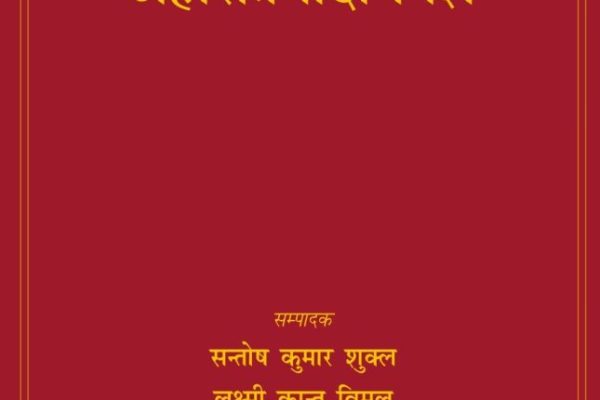
Ahoratravada-vimarsha

Editors: Santosh Kumar Shukla, Lakshmi Kant Vimal, Mani Shankar Dwivedi Ahoratravada is one of the several books authored by Pandit Madhusudan Ojha on the process of Creation. The term aho-ratra means day and night. Examining various concepts of creation, Ojhaji chose to dwell at length on the cycle of day and night as the possible cause of Creation. His references include Rigveda’s agamarshan sukta and nasadiya sukta, Bhagavada Gita, Brahdaranyakopanishad. In the book, Ojhaji has dealt with issues like jnana-ajnana, shukla-krishna, prakash-andhakar, bhava-abhava, sristhi-pralaya, rit-satya, yajna and other concepts. In the present volume, the editors have included a commentary on Pandit Ojhaji’s Ahoratravada along with research papers of several scholars who were invited to take part in discussions on the subject by Shri Shankar Shikshayatan.

Read More

Vedic Srishti Prakriya

Editors: Santosh Kumar Shukla, Lakshmi Kant Vimal, Mani Shankar Dwivedi Vidyavachaspati Pandit Madhusudan Ojha spent most of his life in understanding, examining and writing on the mysteries of Creation. Of the many books, his ten volumes on the cause and process of Creation merit greater appreciation. The present volume contains the text of Ojhaji’s book, Sanshayataduchhedavada, and various research papers written by scholars invited by Shri Shankar Shikshayatan.

Read More

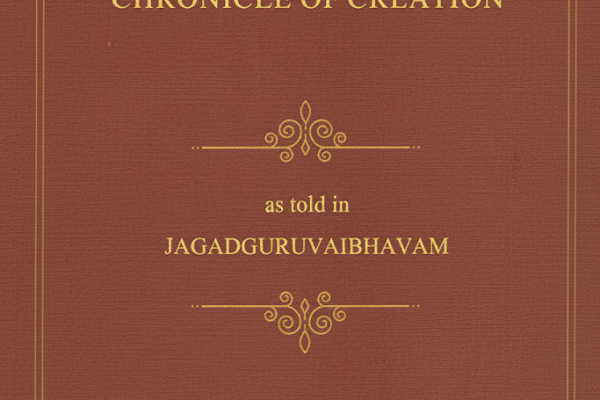
Brahma’s Universe -The Chronicle Of Creation

Author: Pandit Madhusudan Ojha Translator: Kapil Kapur Renowned Vedic scholar, Pandit Madhusudan Ojha has presented in this volume a rich and ancient history of our world and civilisation. The Brahma’s Universe: The Chronicle of Creation is the English translation of Jagadguruvaibhavam prepared by a board of editors at Shri Shankar Shikshayatan headed by well-known indologist, Prof. Kapil Kapoor. Jagadguruvaibhavam, the final part of the trilogy authored by Ojhaji on various facets of Creation, is as much an insightful work on the Vedic knowledge contained in the Vedas and Puranas as also an exceptional example of his profound knowledge and wisdom. Indravijayaha (Bharatavarsa: The India Narrative in English) and Devasurkhyati are the first two volumes on the subject. The Brahma’s Universe: The Chronicle of Creation is the English translation of Jagadguruvaibhavam prepared by a board of editors at Shri Shankar Shikshayatan headed by well-known indologist, Prof. Kapil Kapoor. Brahma is the central character of this book and through his forms, age and abode, Ojhaji has outlined the story of our universe’s evolution. It was Brahma who perceived that, in this world, the source of energy is the surya or sun. All spiritual, metaphysical and supraphysical energies are existent in the surya. The vital energy or prana , which gives life to all beings, too is produced from the sun. Brahma recorded all these in granthas (volumes) that came to be known as the Vedas. Written in verse form, the volume offers a unique rendering of the creation of atma, veda, praja and dharma. Ojhaji presents a remarkable insight into the ancient knowledge on rivers, mountains, eras and communities like Sadhyas and Manijas. Brahma’s Universe is more than a companion book of Bharatavarsa-The India Narrative. It expands the magnificent narrative of Creation, offers broader meaning to Vedic terms and illuminates the profound wisdom contained in the Vedas. प्रसिद्ध वैदिक विद्वान, पंडित मधुसूदन ओझा ने इस खंड में हमारी दुनिया और सभ्यता का एक समृद्ध और प्राचीन इतिहास प्रस्तुत किया है । सृष्टि के विभिन्न पहलुओं पर ओझा जी द्वारा लिखित त्रयी का अंतिम भाग जगद्गुरुविभवम, वेदों और पुराणों में निहित वैदिक ज्ञान पर एक व्यावहारिक कार्य है और साथ ही उनके गहन ज्ञान और ज्ञान का एक असाधारण उदाहरण भी है । इंद्रविजय (भारतवर्ष: अंग्रेजी में भारत कथा) और देवसुरख्यति इस विषय पर पहले दो खंड हैं ।ब्रह्मा का ब्रह्मांड: द क्रॉनिकल ऑफ क्रिएशन प्रसिद्ध इंडोलॉजिस्ट, प्रो कपिल कपूर की अध्यक्षता में श्री शंकर शिक्षायतन में संपादकों के एक बोर्ड द्वारा तैयार जगद्गुरुवैभवम का अंग्रेजी अनुवाद है ।ब्रह्मा इस पुस्तक का केंद्रीय चरित्र है और अपने रूपों, आयु और निवास के माध्यम से, ओझा ने हमारे ब्रह्मांड के विकास की कहानी को रेखांकित किया है । यह ब्रह्मा था जिसने माना था कि, इस दुनिया में, ऊर्जा का स्रोत सूर्य या सूर्य है । सूर्य में सभी आध्यात्मिक, आध्यात्मिक और अतिभौतिक ऊर्जाएं मौजूद हैं । प्राण ऊर्जा या प्राण , जो सभी प्राणियों को जीवन देती है, भी सूर्य से उत्पन्न होती है । ब्रह्मा ने इन सभी को ग्रंथों (संस्करणों) में दर्ज किया, जिन्हें वेदों के रूप में जाना जाने लगा ।पद्य रूप में लिखा गया, खंड आत्मा, वेद, प्रजा और धर्म की रचना का एक अनूठा प्रतिपादन प्रदान करता है । ओझा जी नदियों, पहाड़ों, युगों और समुदायों जैसे साधुओं और मनीजों पर प्राचीन ज्ञान में एक उल्लेखनीय अंतर्दृष्टि प्रस्तुत करते हैं । ब्रह्मा का ब्रह्मांड भारतवर्ष की एक साथी पुस्तक-द इंडिया नैरेटिव से अधिक है । यह सृष्टि की शानदार कथा का विस्तार करता है, वैदिक शब्दों को व्यापक अर्थ प्रदान करता है और वेदों में निहित गहन ज्ञान को प्रकाशित करता है ।

Read More