admin

National Seminar on Gitavijnanabhashya-Gitavishayarahasya

Report Shri Shankar Shikshayatan in collaboration with Dr Shyama Prasad Mukherjee University, Ranchi, organised a national seminar on Gitavijnanabhashya-Gitavishayarahasya on November 26,2022. The seminar was based on Pandit Madhusudan Ojha’s commentaries on Bhagavad Gita. His commentaries are divided into four sections–rahasya khanda, sheershaka khanda, acharya khanda and hridaya khanda. In rahasya khanda, he has detailed Gita-nama-rahasya, Gitashastra-rahasya and Gita-vishaya-rahasya. The seminar focused on Gita-vishaya-rahasya. In vishaya rahasya, Ojhajji has dwelt with atma in this chapter. Opening the discussion, Dr Dhananjay Vasudev Dwivedi of Dr Shyama Prasaid Mukherjee University, said in vishaya-rahasya, Ojhaji has explained bhakti yoga. Meditation is the medium for bhakti. There are three types of  meditations–satyavati, angavati and anyavati. Ojhaji has defined these different types. Satyavati is where budhi or intellect and jnana or knowledge work in tandem. Full dedication to acquire knowledge is angavati. Anyavati is when intellect and sight are at conflict.  Dr Renu Kochar Sharma of Allahabad University, Prayagaraj, spoke on atma-nivarchan. She explained how kshara-purusha, akshara-purusha and avyaya-purusha make creation happen. Dr Sanjit Kumar Jha of Chandradhari Mithila College, Darbhanga, focused on Brahma and karma and how these two elements cause creation.Dr Praveen Kumar Dwivedi of Prof. Rajendrasingh University, Prayagraj, spoke on karma-yoga. Dr Ranjan Lata of Deen Dayal Upadhyaya University Gorakhpur, elucidated on bhakti-yoga. Dr Satyendra Kumar Yadav of Sampurnanand Sanskrit University, Varanasi, spoke on budhi-yoga. He explained about vairagya-budhi, jnana-bidhi, aishwarya-budhi and dharma-budhi.  Prof. Santosh Kumar Shukla, convener, Shri Shankar Shikshayatan, explained how Ojhaji has encapsulated the entire veda vijnana in his commentary on Gita. The programme was coordinated by Dr Lakshmi Kant Vimal and Dr Mani Shankar Dwivedi of Shri Shankar Shikshayatan.
Read More

Pandit Motilal Shastri Memorial Lecture 2022 and Rishi Samman

“Ultimate Dialogue is dialogue with self“ Lecture on Rishi Kumar Mishra’s The Ultimate DialogueBy Prof. Kapil Kapoor In essence, The Ultimate Dialogue is the dialogue between Arjuna and Krishna in Bhagavad Gita, said Prof. Kapil Kapoor, noted linguist, in his address at the Pandit Motilal Shastri Memorial Lecture on September 28, 2022. Prof. Kapoor was also honoured with Rishi Samman, an award instituted by Shri Shankar Shikshayatan to honour Sanskrit and Vedic scholars who have dedicated their life to the study of veda vijnana. Shri Shankar Shikshayatan organises the lecture to honour Shastriji on the birth anniversary of its founder, Rishi Kumar Mishra. Mishraji was the chosen disciple of Shastriji. Standing in Kurukshetra, Arjuna, who all along was eager to engage in a war with Kauravas, was paralysed by a dilemma, became sad and had several questions haunting him. He asked 21 questions to Bhagwan Krishna and if minor questions were also to be included, it would amount to 25 questions in all. If we were to study these questions and their answers, we can understand the deep meaning of Bhagavad Gita. These 21 questions are contained in 700 slokas, 18 chapters and 18 yoga. Prof Kapoor explains Arjuna’s dilemma on whether jnana was superior to karma, and if so, he asks Bhagwan Krishna, if jnana was so superior, then why do you ask me to carry out such a heinous act. Bhagwan replies–Jnana is no different from karma. Jnana is also karma. Jnana itself is karma. If that were the case, why does Bhagwan persuade Arjun to follow the path of karma. Mishraji has vividly explained the meaning of two important terms, buddhi and mana. Mana as sankalp-vikalp, resolution and doubt, and buddhi as nirnayatmaka or decisive. There is a relationship between karma and jnana. Adi Shankaracharya has explained these terms in his Vivekachudamani. Of these paths, if we have to choose one, which path should we take? Which path should Arjuna take? Bhagwan replied that he should take the path of karma. It is superior because jnana is dependent on karma. How do you understand this? In universal consciousness (chetana), three elements are present, they are in conflict and in fusion. These elements are jnana, karma and buddhi. When these elements, despite conflict and tension, merge, they become consciousness. This consciousness makes us realise that the differences we witness are virtual but not in reality it is a continuous, unbroken existence; there are no differences. In bhedha buddhi, we see only objects. But when we rise above them, we can witness their relationship with each other. Prof. Kapoor posed that the basic question in Bhagavad Gita revolved around us and them. It is related to anekta or plurality. If Brahma is one, how can Brahma be present in all of us. In our culture, many wisemen have contemplated this question. We can see the differences but not the one unit from where it all emerges. Like waves, droplets and froth in a river are all but water, the whole universe is the elliptical shaped product of Brahman. Other speakers who spoke on the occasion included prof. Omnath Vimli who dwelt on the meaning of ultimate dialogue. The meeting was coordinated by Dr Mani Shankar Dwivedi and Dr Lakshmi Kant Vimal of Shri Shankar Shikshayatan. Read edited transcript

Read More

Workshop on Maharshikulavaibhavam

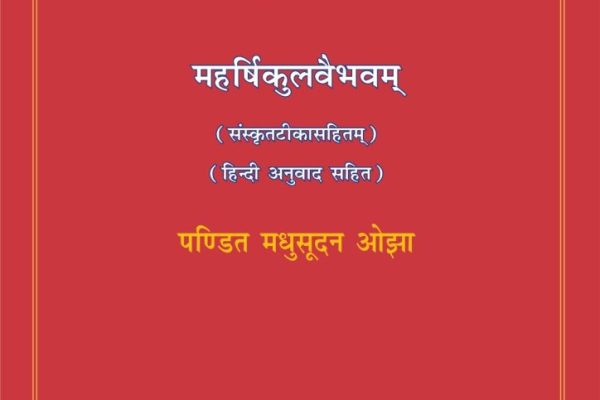
May 15, 2016 A workshop was organised on Pandit Madhusudan Ojha’s Maharshikulavaibhavam, a comprehensive work on the meaning and concept of the term, rishi. In his inaugural address, Prof Baldev Raj Sharma (Delhi University) said rishi was the primary source of Indian knowledge tradition. The rishis presented the matter as they perceived. The main points of discussion were: the use of the term rishi in Sanskrit poetry, reference to rishi in the puranas, in the nirukta, one of the six Vedangas, and rishi-tatva in Maharshikulavaibhavam.

Read More

Workshop on Brahmasidhanta

January 17, 2015 Ojhaji’s book, Brahmasidhanta, formed the basis of a workshop in Delhi, The first meeting was organised in collaboration with the Indian Archaeological Society. In his address, Prof. Shudhanand Pathak said Ojhaji in his book has explained terms and concepts as given in the Brahmasutra. The workshop saw discussion on the philosophical nature of relationships; the nature of maya, atma, karma and bala, among others.

Read More