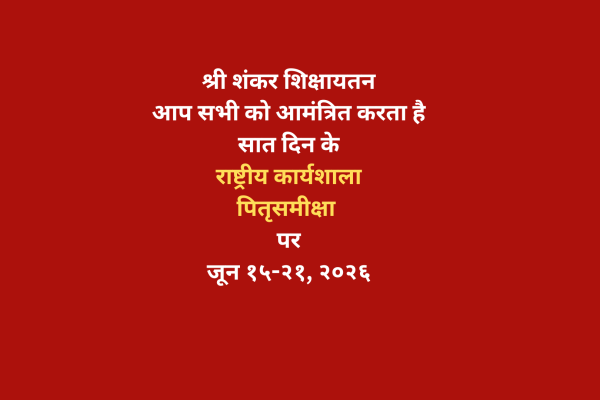
Seven-day National Workshop on Pitrasameeksha
Shri Shankar Shikshayatan Vedic Research Institute organised a seven-day National Online Workshop from 15–21 June 2026.The workshop was based on Pitrisameeksha, a treatise composed by Pandit Madhusudan Ojha, and explored its philosophical and scientific interpretation of the concept of the Pitrs (Ancestors). First Day Prof. Sadashiva Kumar Dwivedi, Senior Professor and Head, Department of Sanskrit, Faculty of Arts, Banaras Hindu University, Varanasi, delivered the inaugural lecture. He observed that Pitrisamiksha has great relevance in the modern age. During the dark fortnight (Krishna Paksha) of the month of Ashvina, the annual Pitru Paksha is observed, when offerings (tarpana) are made to one’s ancestors. The scriptures prescribe Deva Tarpana, Rishi Tarpana, Gotra Tarpana, and other such rites. Referring to the text, he explained that the discussion begins with Prajapati and proceeds to define the nature of the Pitrs. Brahman is described as being of two kinds: Nirukta (manifest) and Anirukta (unmanifest). Nirukta is further classified into three forms: Vishva, Vishvatma, and Vishvatita. The universe created by Brahman is called Vishva; when Brahman enters that universe, it is known as Vishvatma; and that which transcends both is Vishvatita. Dr. Patanjali Kumar Pandey, Assistant Professor, Department of Veda, Maharshi Panini Sanskrit and Vedic University, Ujjain, explained the innovative interpretation of the word Yajus presented in the text. He noted that Yajus is analysed into two components: Yat, representing movement, and Ju, representing stability. In creation, the moving principle is Vayu (air), while the stable principle is Akasha (space). Speech (Vak) resides in space, whereas Vayu signifies life-force (Prana). Through the interaction of Vak and Prana, the structure of creation remains stable. Second Day Prof. Dharmadatta Chaturvedi, Professor, Department of Sanskrit, Central Institute of Higher Tibetan Studies (Deemed University), Sarnath, Varanasi, described the work as immensely beneficial to society and emphasized the need for its wider dissemination. He explained that the life-force manifests in three forms: as the Rishi-Prana (Brahmic form), Deva-Prana (divine form), and Pitri-Prana (ancestral form). A proper understanding of the Pitri principle arises through the harmonious integration of these three forms of Prana. The two principles of Brahma Satya and Deva Satya together produce the twofold refinement (samskara) of living beings. Dr. Kuldeep Kumar, Assistant Professor, Department of Sanskrit, Central University of Himachal Pradesh, Dharamshala, presented a line-by-line reading of the text. He explained that Pitrisamiksha offers detailed interpretations of the concepts of Rta and Satya, both of which are equally significant and should not be viewed hierarchically. The Vishnu principle represents movement and brings Soma-like nourishment from the external world. The Indra principle signifies Prana and brings forth the inner fire residing within the living body. The locus where this process occurs is the Brahma principle, designated in the text by the term Pratishtha (foundation). Third Day Prof. Shyamdev Mishra, Professor, Department of Jyotisha, Central Sanskrit University, Lucknow Campus, explained that Agni, Yama, and Soma constitute the three divine Pitrs (Deva-Pitrs). All the gods originate from the Angira principle, which is inherently luminous; therefore, Agni is radiant in nature. Bhrigu, being associated with affection and essence, is identified with Soma. The state where neither brilliance nor affection exists is designated as the Yama principle. Thus, these three together constitute the three Pitrs. Prof. Shashikant Dwivedi, Professor, Department of Vedic Philosophy, Faculty of Sanskrit Learning and Dharma Studies, Banaras Hindu University, explained that Agni occupies the foremost position in the exposition of the Pitri principle. The intrinsic nature of Agni is expansion. Through Agni, energy extends from the heart, the central point, to the outer regions. Corresponding to the threefold Savana, Agni manifests in three forms: Agni, Vayu, and Aditya. In the evolutionary process, Agni represents the earliest stage, followed by Vayu, and finally Aditya, the most subtle and refined manifestation. Fourth Day Prof. Krishna Kant Jha, Head, Department of Sanskrit, Lalit Narayan Mithila University, Darbhanga, explained that the author interprets Yama on the basis of Prana. The word Vivasvan denotes the Sun, within whose life-force resides the Vishvamitra Prana. This Prana assumes the form of the Brhati metre and is identified with Indra. Consequently, Indra is also understood as Prana. The union of Vishvamitra Prana and Indra Prana gives rise to Manu Prana, and the Agni established within Manu Prana is called Yama. Dr. Ramchandra, Assistant Professor, Institute of Integrated and Honours Studies, Kurukshetra University, explained that when Agni moves from its place of origin together with Vayu in nature, it is called the Rta principle. The term Rtu is used for Agni in this context. Rta-Agni has ten forms: eight Dhishnya Agnis, together with Gayatra Agni and Savitra Agni, making ten manifestations in all. Fifth Day Dr. Kaushalendra Das, Assistant Professor, Department of Philosophy, Jagadguru Ramanandacharya Rajasthan Sanskrit University, Jaipur, explained that after the rite of Sapindikarana in the Shraddha ceremony, the Parvana rite is performed. In Indian tradition, Parvana is generally observed on the new moon (Amavasya), and householders also perform it during the Ardra constellation. The Parvana Pitrs occupy a position below the Nandimukha Pitrs and possess embodied forms. They are classified into four categories: Somapa, Havirbhuj, Ajyapa, and Sukalin, among which the Somapas are primarily referred to as the Parvana Pitrs. Prof. Shobha Mishra, Professor, Department of Sanskrit, Vikramajit Singh Sanatan Dharma College, Kanpur, delivered a lecture on Preta-Pitrs. She explained that after death, the individual soul leaves the earthly body and ascends to higher realms through a Gandharva body to the lunar world. Accordingly, the Preta-Pitrs are classified into three categories: Para, Madhyama, and Avara. The Nandimukha and Parvana Pretas belong to distinct levels, while the Avara are described as Ashrumukha. Sixth Day Dr. Arvind Kumar Tiwari, Lecturer, Adarsh Vedic Sanskrit Inter College, Baghpat, Uttar Pradesh, explained that the Rtu-Pitrs and Divya-Pitrs generate the conscious human body. After experiencing the fruits of actions in higher realms, the individual soul returns from the world of enjoyment (Bhoga-loka) and, becoming a Karmatma-Bhutatma, moves through embodied existence. Prof. Saroj Kaushal, Former Head, Department of Sanskrit, Jai Narain Vyas University, Jodhpur, discussed the role of progeny in the doctrine…